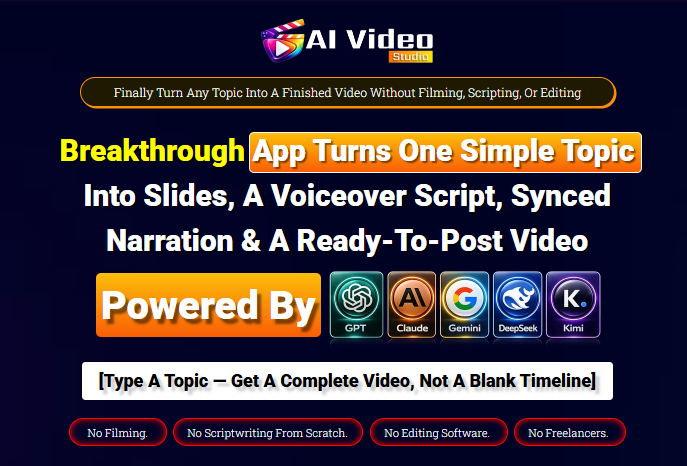
AI Video Studio is the best AI app that turns one simple topic into slides, a voiceover script, synced narration, and a ready-to-post video powered by GPT-5.5 Pro, Claude Opus, Gemini 3.1 Pro, DeepSeek, and Kimi K2.6. Read this full AI Video Studio review for features, OTOs, and how creators turn topics into finished videos without filming.
AI Video Studio Review 2026: Turn One Simple Topic Into a Finished, Ready-to-Post Video
AI Video Studio goes after the exact reason most people never start making videos: the gap between having an idea and having something you can actually publish. You know your topic. You could talk about it for ten minutes without a script. But turning that knowledge into slides, a voiceover, timed narration, and a clean export feels like three different jobs stacked on top of each other, and most people quietly give up somewhere in the middle.
That is the specific problem this tool is built to solve. AI Video Studio is the AI app that turns one simple topic into slides, a voiceover script, synced narration, and a ready-to-post video, powered by GPT-5.5 Pro, Claude Opus, Gemini 3.1 Pro, DeepSeek, and Kimi K2.6. Turn any topic into a finished video without filming, scripting, or editing. Instead of one AI model doing all the work with mixed results, it pulls from several leading models and lets each one contribute to a different part of the process, from research and script writing to pacing and delivery.
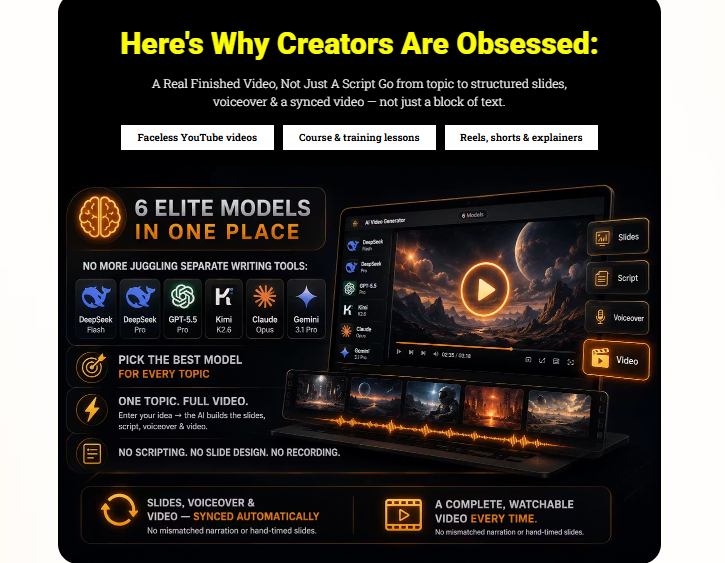
That multi-model approach is worth pausing on, because it separates this from a single-engine video generator. GPT-5.5 Pro and Claude Opus tend to be strong for structured writing and reasoning. Gemini 3.1 Pro brings speed and broad context handling. DeepSeek and Kimi K2.6 have both drawn attention for cost-efficient, high-quality output in head-to-head model comparisons. Combining several of these inside one workflow means you are not stuck with whatever one model happens to be good or bad at on a given day. If you want a clear, practical breakdown of the features, workflow, package, OTOs, benefits, and money-making paths, this review walks through it in plain language.
What Is AI Video Studio?
AI Video Studio is a video creation platform built around a simple loop: you give it a topic, and it hands back a finished, publish-ready video. Instead of separating research, scripting, slide design, voice recording, and syncing into five different tools, the platform is designed to run that entire chain from one input.
Here is the process as it is described. You type in your topic or subject. The system uses its connected AI models to research the angle, structure a narrative, and write a voiceover script that actually flows like something a person would say out loud. From there, it builds matching slides or visual scenes for each script section, generates a synced narration track, and times everything so the visuals and voice line up cleanly. The output is a video file ready to upload, not a rough draft that still needs three more editing passes.
The multi-model design matters here because different AI systems have different strengths. Using several models together, rather than depending on just one, is meant to produce more consistent scripts, cleaner pacing, and fewer awkward phrasing moments than a single-model tool locked into one style.
Who this fits:
-
YouTubers and course creators who want faster production
-
Coaches and consultants who need explainer videos without filming
-
Affiliate marketers building review or educational content
-
Small business owners needing product or service explainer videos
-
Anyone who has a topic worth sharing but no time for a full production pipeline
A fair note before you get excited: this tool removes the mechanical bottleneck of scripting, slide-building, and syncing. It does not replace picking a topic people actually want to watch, or reviewing the output before you hit publish. Treat it as a production accelerator, not a magic content strategy.
AI Video Studio Video DEMO
— watch the full walkthrough: entering a simple topic, watching the AI models generate a structured voiceover script, seeing matching slides or scenes built automatically, reviewing the synced narration track lined up with each visual, and exporting a finished, ready-to-post video.)
AI Video Studio Features List
Topic-to-Video Automation
Enter one topic and the system builds the full video pipeline from research through export.
Multi-Model AI Engine
Draws on GPT-5.5 Pro, Claude Opus, Gemini 3.1 Pro, DeepSeek, and Kimi K2.6 rather than relying on a single AI model for every task.
Automated Script Writing
Generates a voiceover script structured for spoken delivery, not just written text dropped onto a screen.
Slide and Scene Generation
Builds matching visuals for each section of the script, so the video has a coherent visual flow.
Synced Narration
Times the voiceover to line up with each slide or scene automatically, removing manual audio syncing work.
No Filming Required
The entire workflow is designed so you never need a camera, a studio, or on-camera delivery.
No Manual Scripting Needed
You provide the topic. The AI models handle structuring and writing the script content.
No Traditional Editing Required
Slides, narration, and pacing come together inside the platform instead of a separate editing timeline.
Ready-to-Post Export
Output is designed to be published directly rather than requiring further post-processing.
Model Flexibility for Different Content Styles
Different topics may benefit from different underlying models, and the platform’s multi-model setup is built to accommodate that variation.
AI Video Studio Special Features
- Topic-To-Video Engine — Turn any topic or niche into a full video, not a blank page.
- Auto Google Slides — AI generates slide titles & key bullet points automatically.
- AI Voiceover Script + Narration — A full script is written and converted into speech.
- Slides-To-Video — Slides become visual frames, synced with the voiceover.
- Smooth Transitions & Timed Slides — Fade & slide transitions, timed display, synced narration.
- 6 AI Models Built-In — DeepSeek Flash, DeepSeek Pro, GPT-5.5 Pro, Kimi K2.6, Claude Opus & Gemini 3.1 Pro.
- Tone & Length Controls — Set tone (professional, casual…) and target video length.
- Built-In Basic Editor — Trim, retime slides, add music & simple text overlays.
- Background Music — Add a soundtrack without leaving the platform.
- Simple Text Overlays — Add on-screen text without extra editing software.
- Basic Transitions — Fade & slide transitions between every scene.
- Any Niche, Any Topic — Faceless YouTube, ads, explainers, courses & reels.
- Structured Content — AI organizes your topic into a clean slide-by-slide flow.
- Bullet-Point Breakdown — Key points generated for each slide automatically.
- Timed Slide Display — Every slide is shown for the right amount of time.
- Synced Narration — Voiceover matched perfectly to each slide.
- ️Cloud-Based — No downloads or installs; works from any browser.
- Any Device — Windows, macOS, Android, iOS or tablet.
- Internal Preview — Preview generated slides inside the platform before rendering.
- Regenerate Anytime — Not happy with a slide or script? Generate again.
- MP4 Export & Unlimited Downloads — Standard-format, share-ready output.
- Commercial License — Sell videos to clients & keep 100% of the profit.
- Future Model Updates — New AI models added to your account automatically.
- Beginner-Friendly — No editing skills. Just enter a topic → generate → download.
AI Video Studio Simple Workflow
Step 1: Choose one clear topic.
Specific beats vague. “Five budgeting mistakes beginners make” works better than “money tips.”
Step 2: Enter the topic into AI Video Studio.
Let the system’s connected AI models start the research and scripting process.
Step 3: Review the generated voiceover script.
Check the structure and flow before moving to the visual stage.
Step 4: Let the system build matching slides or scenes.
Visuals are generated to align with each script section.
Step 5: Review the synced narration.
Confirm the voice and pacing feel natural against the visuals.
Step 6: Make any small edits needed.
Adjust wording, visuals, or pacing if something feels off before finalizing.
Step 7: Export the finished video.
The output is built to be ready-to-post rather than a rough cut.
Step 8: Publish to your platform of choice.
YouTube, social feeds, course platforms, or client deliverables all work as destinations.
Step 9: Track how the video performs.
Watch retention and engagement to see what topics and formats connect.
Step 10: Repeat with your next topic.
Once you know the flow, later videos move noticeably faster than your first one.

What Is Inside the AI Video Studio Package
Based on the product’s positioning, the front-end package is generally built around:
-
Full access to the AI Video Studio platform
-
Topic-to-script generation powered by multiple connected AI models
-
Automated slide or scene creation matched to the script
-
Synced narration and timing tools
-
Export functionality for ready-to-post video files
-
Access to a multi-model engine spanning GPT-5.5 Pro, Claude Opus, Gemini 3.1 Pro, DeepSeek, and Kimi K2.6
Exact usage limits, video length caps, and export quality options can vary by plan tier, so confirm the specific details on the live order page before purchasing.
AI Video Studio OTO Upgrade Path
Software launches structured like this commonly include optional upgrades after the front-end purchase. Based on typical patterns for tools in this category, possible OTOs may include:
OTO 1 — Higher Usage Limits or Pro Access
Removes front-end caps for users creating a higher volume of videos regularly.
OTO 2 — Advanced Voice and Style Options
Additional voice choices, tones, or visual styles for more brand-specific output.
OTO 3 — Longer-Form Video Support
Expanded capability for longer training videos, courses, or in-depth explainer content.
OTO 4 — Commercial or Agency Rights
Broader licensing for marketers and freelancers producing videos for clients.
OTO 5 — Additional Publishing Integrations
Direct publishing or scheduling connections to platforms beyond manual export.
Bundle Option
A combined package for buyers who want the full feature set without buying each upgrade separately.
Buy upgrades only after producing at least one real video on the front end. That first video tells you exactly which limit, if any, is actually worth paying to remove.
Benefits of AI Video Studio
- You remove the biggest production bottleneck.
Scripting, slide design, and syncing are usually where most people stall out. This tool compresses all three into one flow. - You get more consistent output.
Pulling from multiple strong AI models is designed to reduce the awkward phrasing and shallow structure that a single-model tool can sometimes produce. - You save real production time.
What might take hours across separate tools becomes one continuous process here. - You stay flexible across topics.
Different subjects can lean on different underlying model strengths without you managing that manually. - You do not need filming or editing skills.
The entire pitch is built around removing camera work and timeline editing from your workflow. - You can scale content output.
Faster production per video means more topics covered in the same amount of time.
How to Make Money With AI Video Studio
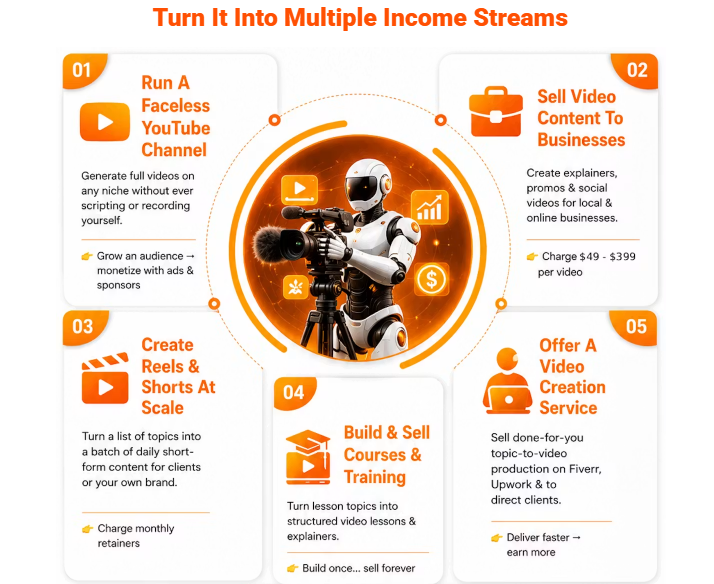
- Publish educational or explainer content on YouTube.
Faster production means more consistent uploads, which supports better channel growth over time. - Create course modules faster.
Coaches and educators can turn outlines into finished lesson videos without a filming setup. - Produce client videos as a freelance service.
Offer explainer or promotional video creation to small businesses that need content but lack production resources. - Support affiliate or review content.
Turn product topics into video reviews that can run alongside written content for extra reach. - Build a faceless content channel.
Since no filming is required, this fits naturally into faceless or anonymous content strategies. - Repurpose one topic into multiple video lengths.
A single well-researched topic can become a short clip, a full explainer, and a course lesson with light adjustments. - Sell video creation as an agency service.
Once your workflow is efficient, packaging this as a monthly service for clients becomes a realistic income stream. - Test more topics with less risk.
Lower production cost per video means you can experiment across more subjects before committing heavily to one niche.


Frequently Asked Questions
What is AI Video Studio?
It is an AI app that turns a single topic into a finished, ready-to-post video, generating the script, slides, and synced narration using multiple connected AI models.
Which AI models does it use?
Public positioning describes a multi-model engine including GPT-5.5 Pro, Claude Opus, Gemini 3.1 Pro, DeepSeek, and Kimi K2.6.
Do I need filming or editing experience?
No. The platform is built specifically to remove filming, scripting, and manual editing from the video creation process.
Can beginners use this without technical skills?
Yes. The workflow is designed around a simple topic input rather than requiring production or design experience.
What is the AI Video Studio OTO?
Optional upgrades that may include higher usage limits, advanced voice options, longer-form video support, or commercial rights, depending on the current funnel.
Will this guarantee viral videos?
No. It automates production. Topic selection, content quality, and audience fit still determine how well any video performs.
Can I use the videos commercially?
Commercial usage rights depend on your specific plan tier, so confirm licensing details before publishing client or monetized content.
How long does it take to produce one video?
Exact time varies by topic complexity and video length, but the workflow is designed to be dramatically faster than manual scripting and editing.
Final Thoughts
Most people do not avoid making videos because they lack something to say. They avoid it because turning an idea into a finished, watchable video feels like a production job on top of everything else they already have to do. AI Video Studio is built directly for that gap, taking a single topic and running it through scripting, slide creation, and narration syncing so you land on a ready-to-post video instead of a pile of half-finished pieces.
If you have topics you have been sitting on because filming and editing felt like too much, this is a practical way to finally get them published. Pick one topic, run it through the system, review the output, and post it. Then repeat with the next idea while the workflow is still fresh.

