SAGA POST is the Never-Ending Story Machine for living, breathing stories and endless episodes — set up your world once, and SagaPost remembers every character, plot, and twist, then generates the next episode forever. Read this full SAGA POST review: features, OTOs, pros and cons, and how creators turn serial fiction into income.
SAGA POST Review 2026: The Never-Ending Story Machine That Never Forgets Your World
You know the moment a serial story dies. Episode one is magic. Episode four still works. By episode nine the hero’s eye color has changed, a dead villain casually walks back in, and a subplot you planted in week two has vanished like it never existed. Readers notice. They always notice. That quiet break in continuity is why so many ambitious story series collapse — not from a lack of ideas, but because the creator’s brain cannot hold an entire living world while also shipping the next chapter on schedule.
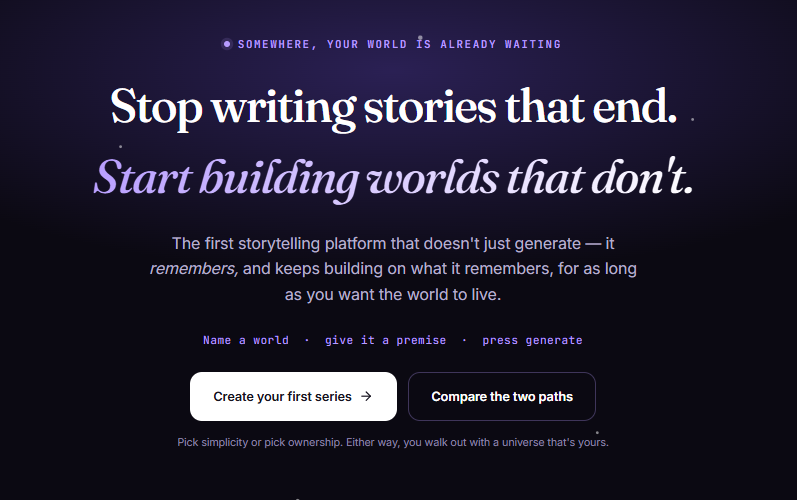
SAGA POST is built for that exact problem. Saga Living, Breathing Stories. Endless Episodes. Welcome to the Never-Ending Story Machine. Set up your world once. SagaPost remembers every character, plot and twist, then generates the next episode forever.
If you want a clear, human look at what SAGA POST actually is, why a persistent story memory changes serialized writing, how the workflow runs, what is inside, how OTOs may stack, the real pros and cons, and honest ways creators make money with endless episodes, this review covers it all.
>> Build Your World Once. Ship Episodes Forever. Get SAGA POST and Stop Losing Track of Your Own Story
What Is SAGA POST?
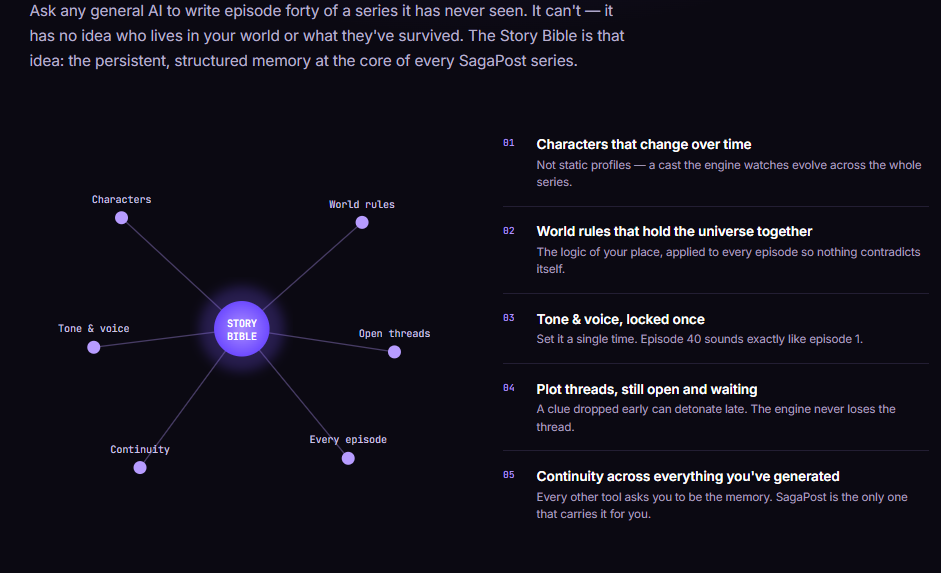
SAGA POST is an AI-assisted serialized fiction workspace built around a simple but powerful idea: a persistent Story Bible that does not forget. You define your world, cast, tone, and major plot threads once. The system stores characters, relationships, locations, and twists, then uses that memory to generate the next connected episode instead of treating every chapter like a brand-new blank page.
Independent reviews describe SagaPost Story Engine as an AI-assisted serialized-fiction workspace built around a persistent Story Bible. It stores characters, plot points, and continuity details so later episodes stay linked to what already happened — the opposite of generic “write me a story” chat tools that reset their brain every session.
The product story in plain language:
-
Living, breathing long-form serials, not one-off short stories
-
Endless episode generation after world setup
-
Memory of characters, plots, and twists across the whole saga
-
A “never-ending story machine” workflow for creators who publish on a schedule
Who it is for is clear:
-
Fiction writers building web serials, newsletters, or episode apps
-
Content creators who want ongoing story arcs for social or membership audiences
-
Game masters and worldbuilders who need consistent lore dumps
-
Indie publishers testing serialized formats before print collections
-
Marketers using story arcs to keep an audience coming back weekly
Important honesty up front: SAGA POST can remember and draft. You still edit for voice, pace, and quality. Continuity software is a co-pilot, not a replacement for taste.
Video Demo and Walkthrough
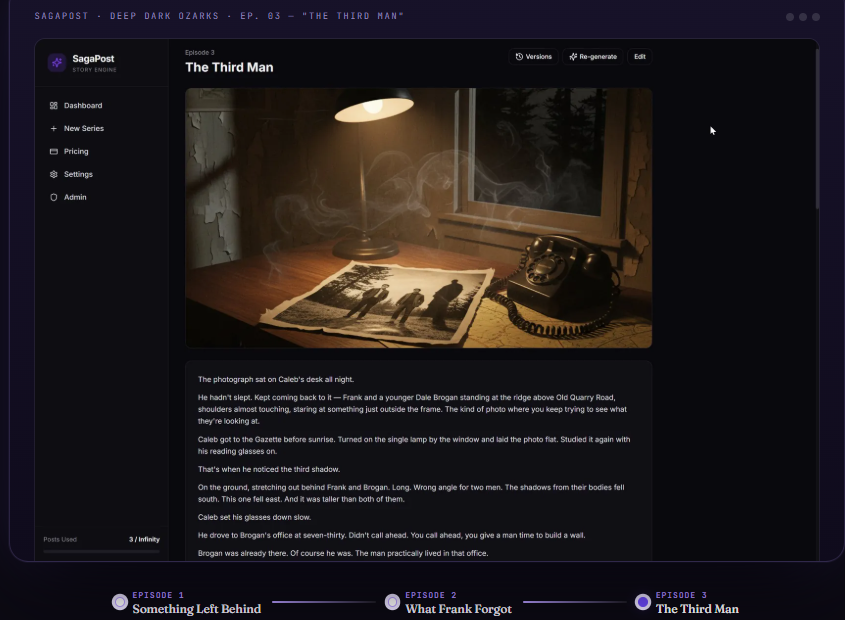
— watch the complete workflow: creating a new saga world, building the Story Bible with characters and core plot threads, generating Episode 1, advancing to Episode 2 and beyond while the system recalls prior twists, reviewing how character traits and relationships stay consistent, and seeing how endless episodes can ship on a schedule without rebuilding context from scratch each time.)
SAGA POST Key Features
The Never-Ending Story Machine Concept
Designed for ongoing serials rather than single short pieces that end after one generation.
Persistent Story Bible
Stores your world rules, cast, and plot memory so later episodes stay connected to earlier ones.
Character Memory Across Episodes
Heroes, villains, and side characters keep their traits, histories, and relationships instead of “soft resetting” every chapter.
Plot and Twist Continuity
Planted clues and arcs can carry forward because the system is built to recall what already happened.
Endless Episode Generation
After setup, you keep requesting the next installment instead of rebuilding prompts from zero.
Living, Breathing Story Framing
Positioned for stories that evolve over time — seasons, arcs, and long-running series energy.
One-Time World Setup
Heavy lifting happens at the start: define the sandbox, then create inside it.
Serialized Fiction Workspace
More than a chat window — a place organized around sagas, episodes, and continuity.
Creator-Friendly Publishing Rhythm
Fits weekly or daily episode schedules common in newsletters, apps, and web fiction.
Edit-Friendly Draft Output
Episodes are meant to be reviewed and polished, not blindly auto-published without a human pass.
Multi-Genre Flexibility
Fantasy, mystery, romance, sci-fi, horror, kids adventure — any genre that benefits from long memory.
Audience Retention Design
Serial format is built for “what happens next” habit loops that keep readers returning.
Why SAGA POST Is Better Than Typical Alternatives
- Versus plain ChatGPT-style story chats
Generic chats forget. You paste summaries forever. SAGA POST is built so the Story Bible carries the load instead of your clipboard. - Versus writing every episode fully by hand
Handcrafted prose can be art. It is also slow. A memory-backed generator helps you ship on a schedule without losing the thread. - Versus one-shot AI story generators
Those tools shine at short tales. They usually collapse on chapter twenty when continuity debt piles up. - Versus complex novel software alone
Scrivener-style tools organize files well but do not invent the next episode. SAGA POST focuses on generation plus memory. - Versus hiring a writers’ room
A room is wonderful at premium TV scale. For solo creators and small brands, software continuity is the affordable version of “someone who remembers the lore.”
What it does not automatically beat: award-level literary prose, deep research historical fiction without fact-checking, or stories that need heavy human emotional nuance in every line. Use SAGA POST for momentum and continuity. Use your judgment for soul.
SAGA POST Workflow — Step by Step
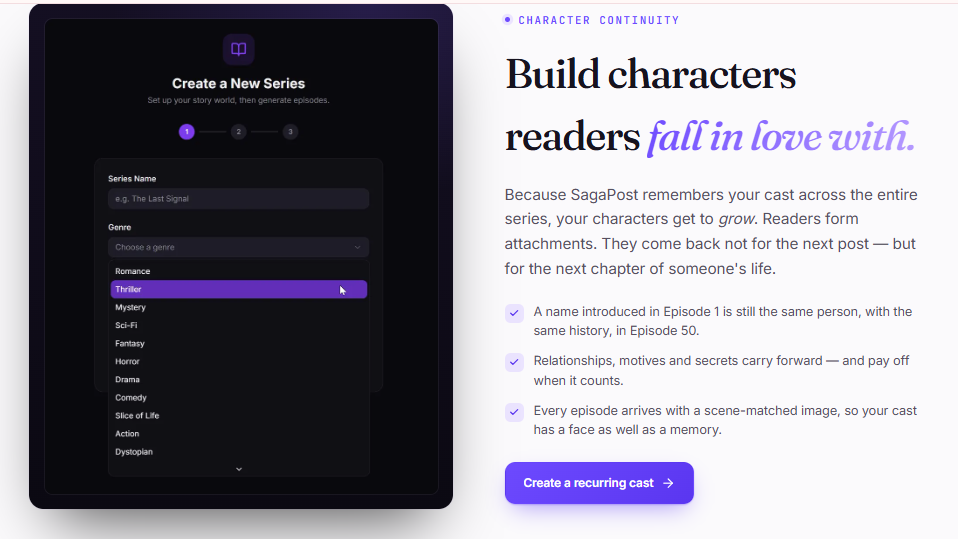
Step 1: Define the saga promise. Decide genre, tone, audience age, and the core “why readers return” hook.
Step 2: Build the world once. Locations, rules, factions, timeline basics — enough structure that later episodes have rails.
Step 3: Create the character cast. Names, goals, flaws, relationships, secrets. This is the heart of continuity.
Step 4: Set major plot pillars. Opening conflict, long-term mystery, season-style arcs, and forbidden twists you want to protect.
Step 5: Generate Episode 1. Establish voice, stakes, and the first cliffhanger that earns Episode 2.
Step 6: Review and lock canon. Edit anything wrong before it becomes “remembered truth” in later chapters.
Step 7: Generate the next episode. Let SAGA POST pull from stored characters, plots, and twists instead of re-explaining everything.
Step 8: Maintain a light human continuity pass. Skim for voice drift, pacing, and accidental contradictions the model might still make.
Step 9: Publish on a fixed cadence. Newsletter, blog serial, membership feed, app episodes, or social story threads.
Step 10: Grow arcs into seasons. When one arc resolves, seed the next — the machine is built for forever, not a single finale.
What Is Inside the SAGA POST Package
Based on official positioning and independent feature descriptions:
-
Access to the SAGA POST / SagaPost story platform
-
Never-Ending Story Machine workflow for endless episodes
-
Persistent Story Bible style memory for characters, plot, and twists
-
Tools to set up a world once and keep creating inside it
-
Episode generation designed for serialized fiction
-
Continuity-focused drafting rather than isolated one-shot stories
-
A creator workspace oriented around living, evolving sagas
-
Support for long-running episode schedules after initial setup
Exact plans, export options, illustration features (if any in your tier), and generation limits depend on the live offer. Check your account dashboard after purchase for the current feature set.
SAGA POST OTO Upgrades
Creative software launches often include one-time offers such as:
OTO 1 — Higher episode limits or faster generation
For daily publishers and multi-saga operators.
OTO 2 — Advanced Story Bible tools
Deeper relationship maps, timeline views, or lore modules.
OTO 3 — Commercial / publishing rights packs
Broader licensing for client work, studio use, or white-label serials.
OTO 4 — Genre template vaults
Ready-made world skeletons for romance, thriller, fantasy, kids adventure, and more.
OTO 5 — Distribution and growth kits
Help turning episodes into newsletters, memberships, or short-video hooks.
OTO 6 — Bundle unlock
Full upgrade stack for creators running SAGA POST as a core business engine.
Buy OTOs after you have shipped several episodes with the core tool. Capacity matters once your audience habit is real.
How to Make Money With SAGA POST
- Launch a paid newsletter serial. Readers pay monthly to unlock the next episodes. Continuity is the product.
- Build a membership story universe. Bonus scenes, character POVs, and side quests become upsell tiers.
- Publish web fiction with tip jars or ads. Free entry chapters, monetized attention, premium early access.
- Sell season compilations as ebooks. When an arc finishes, package it for Kindle or direct PDF sales.
- Create branded story IP for clients. Local brands, game studios, and educators sometimes want ongoing narrative content.
- Support tabletop and game lore. Consistent world bibles help GMs and indie game writers ship campaign drops.
- Turn episodes into multi-format content. Narration podcasts, illustrated posts, or short drama clips from the same saga memory.
- Grow a faceless fiction channel. Regular cliffhangers train algorithms and audiences to return.
- License characters later. Strong, consistent casts become merchandise, spin-offs, and collaborations.
Money follows retention. SAGA POST’s edge is helping you not break the spell that makes people come back.
SAGA POST Pros and Cons
Pros
-
Built specifically for endless serialized stories, not one-off prompts
-
Remembers characters, plots, and twists after world setup
-
Reduces continuity chaos that kills long series
-
Supports a real publishing cadence for creators
-
Beginner-friendly compared with managing lore in scattered docs
-
Flexible across genres and audience types
-
Strong fit for newsletters, memberships, and web serial business models
Cons
-
Output still needs human editing for voice and quality
-
“Forever” episodes only work if you keep directing arcs with intention
-
Weak setup at the start creates weak continuity later
-
Not a substitute for original research in fact-heavy genres
-
Over-reliance without editing can make prose feel samey over time
-
Results depend on your taste in story structure and cliffhangers
Frequently Asked Questions
What is SAGA POST?
SAGA POST is the Never-Ending Story Machine for living, breathing serialized stories — you set up your world once, and it remembers characters, plots, and twists so it can generate the next episode on an ongoing basis.
How is it different from a normal AI writer?
Normal tools often treat each request as isolated. SAGA POST is built around persistent story memory so episodes stay connected.
Do I need to be a professional novelist?
No. You need a clear world idea and willingness to edit. The platform handles a large share of continuity tracking and drafting speed.
Can it really generate episodes forever?
That is the product design: ongoing episode generation after setup. Quality still depends on your guidance and review.
What is the SAGA POST OTO?
Optional upsells after the front end — often more capacity, advanced bible tools, commercial rights, templates, or growth kits.
Can I sell stories made with SAGA POST?
Many creators use AI-assisted drafts commercially, but you must follow the product’s license and the rules of each store or platform you publish on.
Will readers know it is AI-assisted?
They will notice bad continuity and flat prose faster than they notice your toolchain. Edit like a pro and the experience stays immersive.
Who should skip this?
Anyone wanting a single short story with no series plans, or anyone unwilling to do a human quality pass before publishing.
Final Thoughts
Serial fiction fails in the middle more often than at the start. The spark is easy. The memory is hard. SAGA POST exists for creators who want living, breathing stories with endless episodes — a Never-Ending Story Machine where you set up the world once and keep going because the cast, plot, and twists are still there when you come back tomorrow.
If you have abandoned a series because keeping it straight felt heavier than writing it, this is the kind of tool that makes “next episode” feel light again. Build the bible. Ship Episode 1. Protect the canon. Then let the machine help you chase the only question that ever built a loyal fiction audience: what happens next?

